
Join 60,000+ competitive exam aspirants
or with email
Your Cart
Subtotal₹0
Total₹0
Examoogle • User • info@examoogle.com • EE-2024-8821
Chapter 1 of 12 • Page 1 of 248🔒 Protected PDF • Watermarked
An observer on the top of a cliff, 249 m above the sea-level, observes the angles of depression of two ships to be 30°and 60°, respectively. What is the distance (in m) between the ships if they are on opposite sides of the cliff?
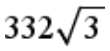
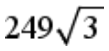
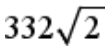
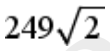
For angles 30° and 60° on opposite sides, the distance is h(3+31)=h(34)=34h. Or simply use hcot(30°)+hcot(60°)=249(3+31)=249(34)=83×4×3=3323.
The distance between two points on opposite sides of a cliff is the sum of the horizontal distances from the cliff base, calculated using the tangent of the depression angles.
Use the formula d=h×(cot(θ1)+cot(θ2)), where h is the height of the cliff and θ1,θ2 are the angles of depression.
Height of cliff h=249 m, angle of depression for ship 1 is 30°, angle of depression for ship 2 is 60°. Ships are on opposite sides.
d=h(tan(θ1)1+tan(θ2)1)=h(cot(θ1)+cot(θ2))
For angles 30° and 60° on opposite sides, the distance is h(3+31)=h(34)=34h. Or simply use hcot(30°)+hcot(60°)=249(3+31)=249(34)=83×4×3=3323.
Students often assume the ships are on the same side and subtract the distances instead of adding them, or incorrectly calculate cot(60°) as 3 instead of 31.
Setup distances for each side
Let d1 and d2 be the distances of the ships from the base of the cliff. Since the angle of elevation equals the angle of depression, for 30°: d1=hcot(30°)=2493. For 60°: d2=hcot(60°)=24931=833.
d1=2493,d2=833
Calculate total distance
Since the ships are on opposite sides, the total distance d=d1+d2.
d=2493+833=3323
A is correct because the sum of the horizontal distances 2493+833 equals 3323 meters.
This logic is identical to finding the combined range of two projectiles or the total separation of two objects from an observer's vertical axis in physics problems.
Get instant step-by-step AI explanations, full shift Previous Year Papers (SSC GD, RRB, SSC JE), and regional rank analysis on the official Examoogle App.
 Free Download • 100K+ Aspirants