
Join 60,000+ competitive exam aspirants
or with email
Your Cart
Subtotal₹0
Total₹0
Examoogle • User • info@examoogle.com • EE-2024-8821
Chapter 1 of 12 • Page 1 of 248🔒 Protected PDF • Watermarked
Consider the following figure: If l 1 ∥ l 2 and l 3 ∥ l 4, then which one of the following relations is correct?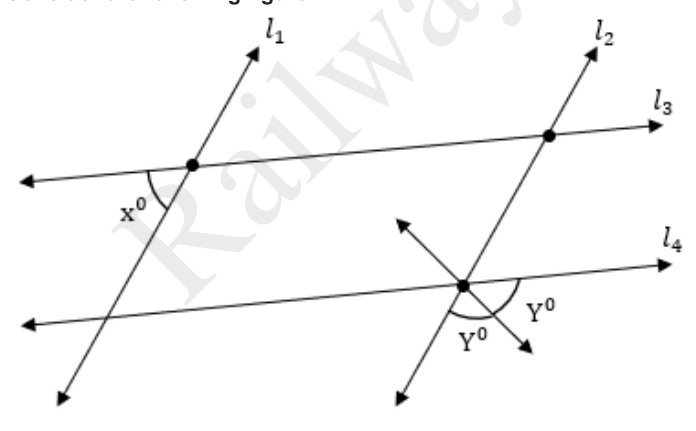
Y° + 2x° = 180°
2Y° + x° = 180°
2Y° = x°
Y° + x° = 180°
2Y° + x° = 180°
Spot that Y and x are alternate interior angles (equal), then substitute Y = x into option (B): 2x + x = 180° → x = 60°, Y = 60°. Only option (B) is consistent.
Lines l₁ ∥ l₂ and l₃ ∥ l₄. Angle x° is at the intersection of l₁ and l₃. Two vertical angles each measuring Y° are at the intersection of l₂ and l₄.
If l1∥l2 and l3∥l4, then alternate interior angles are equal.
Spot that Y and x are alternate interior angles (equal), then substitute Y = x into option (B): 2x + x = 180° → x = 60°, Y = 60°. Only option (B) is consistent.
Students often confuse which angles are alternate interior vs. consecutive interior. Misidentifying Y° as supplementary to x° leads to choosing option (D) instead of (B).
Step 1: Identify Parallel Lines and Transversals
Given l₁ ∥ l₂ and l₃ ∥ l₄. These form pairs of parallel lines cut by transversals, creating equal alternate interior angles.
l1∥l2,l3∥l4
Step 2: Relate x° and Y° via Alternate Interior Angles
Using l₃ ∥ l₄ with transversal l₂, the angle Y° at the lower intersection is an alternate interior angle to the corresponding angle near x°. Also, since l₁ ∥ l₂ with transversal l₃, the angle adjacent to x° corresponds to the angle at the upper right intersection. By alternate interior angles: Y°=x°
Y°=x°
Step 3: Find the Supplementary Relationship
At the intersection of l₂ and l₄, the two vertically opposite angles each measure Y°. Together with the angle equal to x° (from Step 2), these three angles lie on one side of the straight line l₄, so they sum to 180°.
Y°+Y°+x°=180°
Step 4: Simplify to Match an Option
Substituting Y° = x°: x°+x°+x°=180°⇒3x°=180°⇒x°=60°,Y°=60° The relation 2Y°+x°=180° holds.
2Y°+x°=180°
Option B is correct because substituting the alternate interior angle relationship Y° = x° gives 2Y° + x° = 180°, which satisfies 3×60° = 180°.
This concept frequently appears in railway/SSC exams with parallelogram angle properties — remember: when two pairs of parallel lines intersect, they create equal corresponding and alternate interior angles, and consecutive interior angles are supplementary.
Get instant step-by-step AI explanations, full shift Previous Year Papers (SSC GD, RRB, SSC JE), and regional rank analysis on the official Examoogle App.
 Free Download • 100K+ Aspirants