
Join 60,000+ competitive exam aspirants
or with email
Your Cart
Subtotal₹0
Total₹0
Examoogle • User • info@examoogle.com • EE-2024-8821
Chapter 1 of 12 • Page 1 of 248🔒 Protected PDF • Watermarked
Expand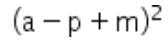




Use the sign pattern for the cross-products: here we have (a)+(−p)+(m). The squares are always positive, and the sign of each 2xy term is determined by the product of the signs of the components.
The expression to expand is (a - p + m)2.
(x+y+z)2=x2+y2+z2+2xy+2yz+2zx
Use the sign pattern for the cross-products: here we have (a)+(−p)+(m). The squares are always positive, and the sign of each 2xy term is determined by the product of the signs of the components.
A common mistake is incorrectly identifying the signs in the cross-product terms, especially when dealing with negative variables like −p.
Identify terms
Rewrite the expression (a−p+m)2 as the sum of three terms: (a+(−p)+m)2.
(a+(−p)+m)2
Apply expansion identity
Substitute x=a, y=−p, and z=m into the algebraic identity (x+y+z)2=x2+y2+z2+2xy+2yz+2zx.
a2+(−p)2+m2+2(a)(−p)+2(−p)(m)+2(m)(a)
Simplify terms
Calculate each term individually: a2 remains a2, (−p)2 becomes p2, m2 remains m2, 2(a)(−p)=−2ap, 2(−p)(m)=−2pm, and 2(m)(a)=2am.
a2+p2+m2−2ap−2pm+2am
D is correct because the expansion of (a−p+m)2 results in a2+p2+m2−2ap−2pm+2am.
This identity is a fundamental building block for polynomial multiplication and factoring techniques frequently tested in competitive examinations.
Get instant step-by-step AI explanations, full shift Previous Year Papers (SSC GD, RRB, SSC JE), and regional rank analysis on the official Examoogle App.
 Free Download • 100K+ Aspirants