
Join 60,000+ competitive exam aspirants
or with email
Your Cart
Subtotal₹0
Total₹0
Examoogle • User • info@examoogle.com • EE-2024-8821
Chapter 1 of 12 • Page 1 of 248🔒 Protected PDF • Watermarked
Match the following.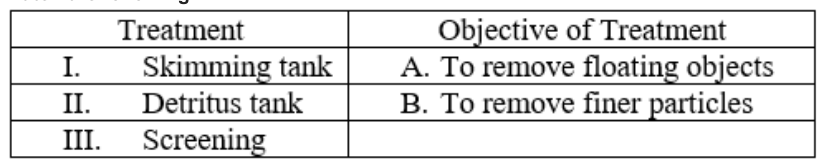
I-A, II-A, III-A
I-A, II-B, III-B
I-B, II-B, III-A
I-A, II-B, III-A
I-A, II-B, III-A
The matching is based on the primary unit operations in sewage treatment: (I) Skimming tanks are designed to remove floating materials like oil, grease, and soap; (II) Detritus tanks are grit chambers used to remove finer suspended particles like sand or grit; and (III) Screening is the preliminary process used to remove large floating or suspended debris (like rags, wood, or plastic).
CPHEEO Manual on Sewerage and Sewage Treatment Systems
The matching is based on the primary unit operations in sewage treatment: (I) Skimming tanks are designed to remove floating materials like oil, grease, and soap; (II) Detritus tanks are grit chambers used to remove finer suspended particles like sand or grit; and (III) Screening is the preliminary process used to remove large floating or suspended debris (like rags, wood, or plastic).
vs=18νg(G−1)d2 — Terminal settling velocity of particles in grit chambers (Stokes' Law)
η=v0vs — Removal efficiency related to settling velocity (vs) and surface overflow rate (v0)
These treatments utilize physical properties like density differences and size exclusion. Skimming tanks rely on buoyancy to float grease to the surface, while Detritus tanks use velocity control to allow heavier grit particles to settle while keeping organic matter in suspension. Screening acts as a mechanical filter with bars or meshes to block objects larger than the clear opening.
Skimming tanks remove materials with specific gravity less than water.
Detritus tanks are specialized grit chambers that specifically target inorganic material (grit/sand).
Screening is always the first stage of primary treatment to protect downstream pumps and pipes.
Prevents clogging of downstream mechanical equipment.
Reduces the risk of scum accumulation in secondary treatment units.
Easily automated and low operational complexity.
Generates large quantities of screening waste that require disposal.
Skimming processes require frequent manual or mechanical removal of surface scum.
Municipal wastewater treatment plants (STPs).
Industrial effluent treatment for industries with high oil and grease content.
Pre-treatment for pumping stations.
Option D correctly links I to A (Skimming → Floating), II to B (Detritus → Finer/Grit particles), and III to A (Screening → Floating objects/Debris).
Note: While screening also removes some floating objects, the specific classification in this context places 'Screening' for large debris and 'Skimming' for specific light floating fractions.
D is correct — Skimming tank removes floating objects, Detritus tank removes finer particles, and Screening removes larger debris/floating objects.
Always remember the sequence of primary treatment: Screens → Grit Chamber (Detritus) → Skimming Tank → Primary Sedimentation Tank.
Get instant step-by-step AI explanations, full shift Previous Year Papers (SSC GD, RRB, SSC JE), and regional rank analysis on the official Examoogle App.
 Free Download • 100K+ Aspirants