
Join 60,000+ competitive exam aspirants
or with email
Your Cart
Subtotal₹0
Total₹0
Examoogle • User • info@examoogle.com • EE-2024-8821
Chapter 1 of 12 • Page 1 of 248🔒 Protected PDF • Watermarked
Join 60,000+ competitive exam aspirants
Riya can complete a piece of work in 15 days, while Neha can complete the same work in 20 days. If both of them work together, how many days will they take to complete the work?
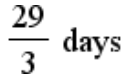
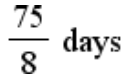
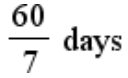
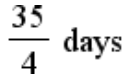
Use LCM method: assign total work = LCM of 15 and 20 = 60 units. Riya's efficiency = 60÷15 = 4 units/day, Neha's = 60÷20 = 3 units/day. Together = 7 units/day → Time = 60/7 days.
Riya completes work in 15 days, Neha completes work in 20 days
T=(aLCM+bLCM)LCM(a,b)
Use LCM method: assign total work = LCM of 15 and 20 = 60 units. Riya's efficiency = 60÷15 = 4 units/day, Neha's = 60÷20 = 3 units/day. Together = 7 units/day → Time = 60/7 days.
Students often add the time values directly (15 + 20 = 35) instead of adding efficiencies, or incorrectly use the formula a1+b1 without proper common denominator.
Find Total Work (LCM)
Take LCM of 15 and 20 to assign total work in convenient units.
LCM(15,20)=60 units
Calculate Individual Efficiencies
Riya's one-day work and Neha's one-day work in units per day.
Riya’s efficiency=1560=4 units/day,Neha’s efficiency=2060=3 units/day
Calculate Combined Efficiency
Add both efficiencies when working together.
Combined efficiency=4+3=7 units/day
Find Time to Complete Work Together
Divide total work by combined efficiency to get time.
Time=760 days
C is correct because the combined work rate yields 760 days to complete the work together.
This LCM-based efficiency method applies universally to all 'two people working together' problems. For three or more workers, simply extend: assign LCM as total work, compute each efficiency, sum them, then divide total work by total efficiency.
Get instant step-by-step AI explanations, full shift Previous Year Papers (SSC GD, RRB, SSC JE), and regional rank analysis on the official Examoogle App.
 Free Download • 100K+ Aspirants