
Join 60,000+ competitive exam aspirants
or with email
Your Cart
Subtotal₹0
Total₹0
Examoogle • User • info@examoogle.com • EE-2024-8821
Chapter 1 of 12 • Page 1 of 248🔒 Protected PDF • Watermarked
Join 60,000+ competitive exam aspirants
1
3
2
4
2
Notice the numerator 7 is common to both fractions; they cancel out. The result is simply the reciprocal of the denominator fraction's denominator relative to the dividend's denominator, which is 816=2.
To divide by a fraction, multiply by its reciprocal (the flipped fraction).
Convert the division expression into a multiplication expression by flipping the second fraction, then simplify.
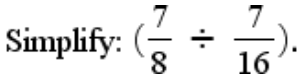
An expression to simplify:87 \div$$\frac{7}{16}
ba÷dc=ba×cd
Notice the numerator 7 is common to both fractions; they cancel out. The result is simply the reciprocal of the denominator fraction's denominator relative to the dividend's denominator, which is 816=2.
Students often mistakenly divide the numerators and denominators separately (7÷7=1 and 8÷16=0.5) resulting in 1÷0.5=2, but confusion arises if they try to divide 8÷16 as 8/16 instead of 16/8.
Convert division to multiplication
To divide by a fraction, we multiply by its multiplicative inverse (reciprocal).
87÷167=87×716
Simplify the expression
Cancel the common factor of 7 from the numerator and denominator.
87×716=816
Calculate the final quotient
Divide 16 by 8 to obtain the final integer result.
816=2
C is correct because the division of fractions 87÷167 simplifies to 87×716=2.
This fundamental rule of 'multiplying by the reciprocal' is the same method used when dealing with complex algebraic fractions or solving equations involving ratios.
Get instant step-by-step AI explanations, full shift Previous Year Papers (SSC GD, RRB, SSC JE), and regional rank analysis on the official Examoogle App.
 Free Download • 100K+ Aspirants