
Join 60,000+ competitive exam aspirants
or with email
Your Cart
Subtotal₹0
Total₹0
Examoogle • User • info@examoogle.com • EE-2024-8821
Chapter 1 of 12 • Page 1 of 248🔒 Protected PDF • Watermarked
Join 60,000+ competitive exam aspirants
46
39
42
50
50
Assume a mean A=50. Calculate deviations di=xi−A: -36, -22, 5, 25, 43. Find mean deviation by summing fidi products: −1188−1782+365+1100+1505=−6. Mean deviation = −6/266≈0. Total Mean = 50+0=50.
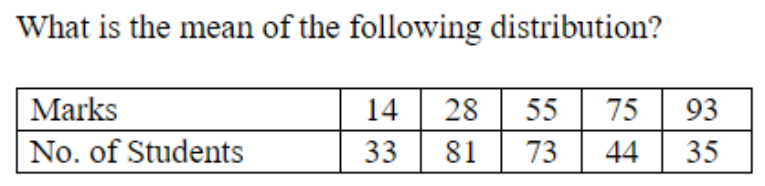
Marks distribution: 14(33), 28(81), 55(73), 75(44), 93(35)
Mean=∑fi∑(fi×xi)
Assume a mean A=50. Calculate deviations di=xi−A: -36, -22, 5, 25, 43. Find mean deviation by summing fidi products: −1188−1782+365+1100+1505=−6. Mean deviation = −6/266≈0. Total Mean = 50+0=50.
Multiplying large numbers like 55×73 or 93×35 and accumulating errors in summation.
Calculate total marks for each group
Multiply each mark by the number of students. For example, 14×33=462, 28×81=2268, 55×73=4015, 75×44=3300, and 93×35=3255.
∑(fi×xi)=462+2268+4015+3300+3255=13300
Calculate total number of students
Sum the number of students across all groups.
∑fi=33+81+73+44+35=266
Apply mean formula
Divide the total marks by the total number of students to find the mean.
Mean=26613300=50
D is correct because the calculated mean is exactly 50.
This step-deviation method (assuming a mean) is equally applicable to grouped frequency distributions with class intervals to minimize calculation effort.
Get instant step-by-step AI explanations, full shift Previous Year Papers (SSC GD, RRB, SSC JE), and regional rank analysis on the official Examoogle App.
 Free Download • 100K+ Aspirants