
Join 60,000+ competitive exam aspirants
or with email
Your Cart
Subtotal₹0
Total₹0
Examoogle • User • info@examoogle.com • EE-2024-8821
Chapter 1 of 12 • Page 1 of 248🔒 Protected PDF • Watermarked
Join 60,000+ competitive exam aspirants
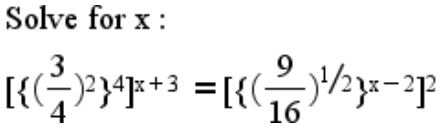

Question ID: 4410091510543 Option 1 ID: 4410095997626 Option 2 ID: 4410095997628 Option 3 ID: 4410095997627 Option 4 ID: 4410095997629 Status: Answered Chosen Option: D
Question ID: 4410091510543 Option 1 ID: 4410095997626 Option 2 ID: 4410095997628 Option 3 ID: 4410095997627 Option 4 ID: 4410095997629 Status: Answered Chosen Option: D
Convert both sides to the same base (3/4), then equate exponents directly — avoids long calculations.
Equation: {[(3/4)2]^4}^(x+3) = {[(9/16)^(1/2)]^(x-2)}^2. Need to find value of x.
am×n=(am)n
Convert both sides to the same base (3/4), then equate exponents directly — avoids long calculations.
Students often mishandle nested exponents like [(aᵐ)^n]^p and incorrectly multiply powers; also confusing (9/16)^(1/2) with (9/16)2.
Step 1: Simplify Left Side
Using power of a power rule: [(3/4)2]4=(3/4)(2×4) = (3/4)8. Then raising to (x+3): ((3/4)8)(x+3)=(3/4)(8(x+3)) = (3/4)^(8x+24)
(43)8x+24
Step 2: Simplify Right Side
First compute (9/16)^(1/2) = 9/16 = 3/4. Then [(3/4)^(x-2)]2=(3/4)(2(x−2)) = (3/4)^(2x-4)
(43)2x−4
Step 3: Equate Exponents
Since both sides have the same base (3/4), set the exponents equal: 8x + 24 = 2x - 4
8x+24=2x−4
Step 4: Solve for x
8x - 2x = -4 - 24 → 6x = -28 → x = -28/6 = -14/3 = -4⅔
x=−314=−432
D is correct because solving the exponential equation yields x = -14/3 = -4⅔ after simplifying both sides to base 3/4 and equating exponents.
This technique of reducing both sides to a common base is widely used in RRB NTPC/Group D exams for指数 equations — always check if you can express all terms with the same base first.
Get instant step-by-step AI explanations, full shift Previous Year Papers (SSC GD, RRB, SSC JE), and regional rank analysis on the official Examoogle App.
 Free Download • 100K+ Aspirants