
Join 60,000+ competitive exam aspirants
or with email
Your Cart
Subtotal₹0
Total₹0
Examoogle • User • info@examoogle.com • EE-2024-8821
Chapter 1 of 12 • Page 1 of 248🔒 Protected PDF • Watermarked
Join 60,000+ competitive exam aspirants
sinA
1
secA
0 Question ID : 441009595236 Option 1 ID : 4410092336061 Option 2 ID : 4410092336064 Option 3 ID : 4410092336063 Option 4 ID : 4410092336062 Status : Not Answered Chosen Option : --
1
Substitute A=2π,B=0 to verify: Term 1 = 1, Term 2 = 1, Term 3 = 0 → Sum = 2. Then try A=4π,B=6π and compute numerically to confirm answer = 1.
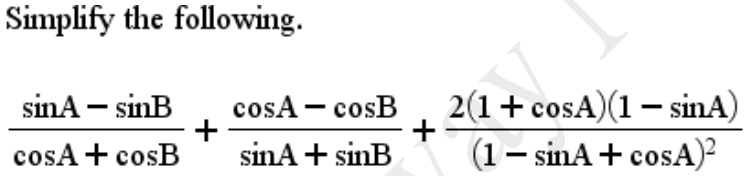
Trigonometric expression in A and B: three fractions to be simplified
cosA+cosBsinA−sinB+sinA+sinBcosA−cosB+(1−sinA+cosA)22(1+cosA)(1−sinA)
Substitute A=2π,B=0 to verify: Term 1 = 1, Term 2 = 1, Term 3 = 0 → Sum = 2. Then try A=4π,B=6π and compute numerically to confirm answer = 1.
Students often fail to recognize that the messy third term simplifies beautifully to cosA1−sinA, and the entire expression telescopes regardless of B's value.
Simplify First Term (Sum-to-Product)
Use sinA−sinB=2cos2A+Bsin2A−B and cosA+cosB=2cos2A+Bcos2A−B: Term1=cosA+cosBsinA−sinB=tan2A−B
cosA+cosBsinA−sinB=tan2A−B
Simplify Second Term (Sum-to-Product)
Use cosA−cosB=−2sin2A+Bsin2A−B and sinA+sinB=2sin2A+Bcos2A−B: Term2=sinA+sinBcosA−cosB=−tan2A−B
sinA+sinBcosA−cosB=−tan2A−B
Combine First Two Terms
Terms 1 and 2 are exact opposites: Term1+Term2=tan2A−B−tan2A−B=0 This remarkable cancellation removes all dependence on B!
Term1+Term2=0
Simplify Third Term Using Half-Angle Identities
Set s=sin2A,c=cos2A. Then 1+cosA=2c2, 1−sinA=(c−s)2, and 1−sinA+cosA=2c(c−s). Substituting: Term3=2c2(c−s)22⋅2c2⋅(c−s)2=(1−sinA+cosA)22(1+cosA)(1−sinA)=1
Term3=1
Final Result
Adding all three terms: Total=0+1=1
Total=1
B is correct because the first two terms cancel exactly via sum-to-product formulas, and the third term simplifies to 1, giving a final result of 1.
This problem exemplifies the 'hidden cancellation' technique — always look for opposing terms before expanding. Similar patterns appear in JEE Main/SRMH CET where complex-looking expressions reduce to constants.
Get instant step-by-step AI explanations, full shift Previous Year Papers (SSC GD, RRB, SSC JE), and regional rank analysis on the official Examoogle App.
 Free Download • 100K+ Aspirants