
Join 60,000+ competitive exam aspirants
or with email
Your Cart
Subtotal₹0
Total₹0
Examoogle • User • info@examoogle.com • EE-2024-8821
Chapter 1 of 12 • Page 1 of 248🔒 Protected PDF • Watermarked
Select the correct mirror image of the given figure when the mirror is placed at OG as shown below.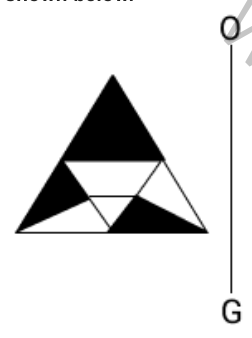
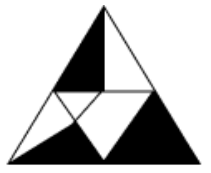
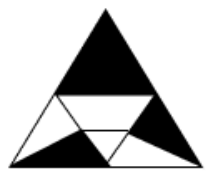
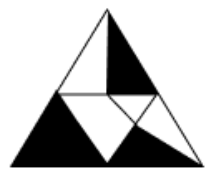
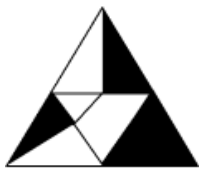
Apply the rule of horizontal inversion: parts on the right of the mirror move to the left, and parts on the left move to the right, while top-bottom orientation remains identical.
Apply the rule of horizontal inversion: parts on the right of the mirror move to the left, and parts on the left move to the right, while top-bottom orientation remains identical.
Analyze the mirror placement
The mirror is placed vertically at the right side (OG). A mirror image in a vertical mirror causes a horizontal reflection (left becomes right, and right becomes left).
Evaluate specific components
The top-most black triangle pointing up stays at the top. The black triangle in the bottom-left of the original figure moves to the bottom-right. The black triangle on the right middle moves to the left middle.
Match with options
By reflecting the original image across the vertical axis, the white and black sections swap positions relative to the vertical centerline. This matches the arrangement shown in Option B.
A: The internal shading pattern is incorrect. C: The position of the shaded triangle in the lower section is wrong. D: The reflection of the upper and central shaded parts does not follow horizontal inversion.
B is correct because it represents the perfect horizontal flip of the original triangular figure as it would appear in a vertical mirror.
For vertical mirror problems, remember that the vertical orientation is preserved; only the left and right sides are interchanged. Always start by checking one unique, non-symmetrical feature of the figure to quickly eliminate incorrect options.
Get instant step-by-step AI explanations, full shift Previous Year Papers (SSC GD, RRB, SSC JE), and regional rank analysis on the official Examoogle App.
 Free Download • 100K+ Aspirants