
Join 60,000+ competitive exam aspirants
or with email
Your Cart
Subtotal₹0
Total₹0
Examoogle • User • info@examoogle.com • EE-2024-8821
Chapter 1 of 12 • Page 1 of 248🔒 Protected PDF • Watermarked
Join 60,000+ competitive exam aspirants
8
10
9
7
7
Systematically count the small triangles (1-unit area) first, then identify the larger combined triangles to ensure no overlap or omission.
Systematically count the small triangles (1-unit area) first, then identify the larger combined triangles to ensure no overlap or omission.
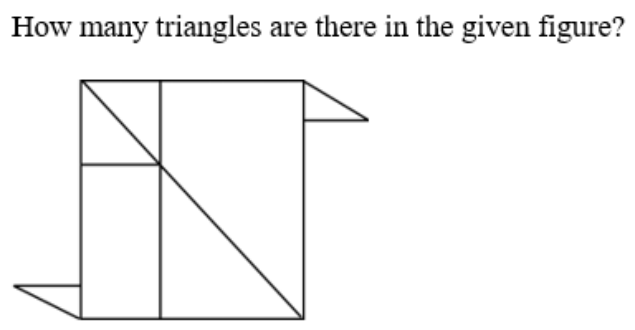
Analyze the main frame
The central square is divided by a diagonal line and an L-shaped partition. The diagonal cuts the main square into two large right-angled triangles. Inside the top-left section, there is a smaller square partition creating a smaller right-angled triangle. This results in 3 triangles within the main square structure.
Identify external and internal triangles
Counting: 1 (top-left tiny triangle), 2 (mid-left triangle formed by diagonal and horizontal divider), 3 (large top-left triangle), 4 (large bottom-right triangle), 5 (the smaller triangle partition inside the left block). In addition, there are two distinct 'wing' triangles attached to the outside of the main square: 6 (top-right wing) and 7 (bottom-left wing).
Final aggregation
Summing the triangles: 5 from the inner segments (1 small top, 1 middle horizontal, 1 large top-left half, 1 large bottom-right half, 1 combined segment) and 2 external wing triangles equals 7 total triangles.
A: 8 is incorrect as it overcounts by including non-existent segments. B: 10 is incorrect as it significantly overestimates the geometric segments present. C: 9 is incorrect as it is an overestimation of the distinct closed triangles.
D is correct because a rigorous physical counting of the distinct geometric regions shows exactly 7 enclosed triangular shapes.
When counting figures, always group segments into 'atomic' (smallest) units first, then count 'composite' (multi-unit) shapes to avoid double-counting or missing hidden triangles.
Get instant step-by-step AI explanations, full shift Previous Year Papers (SSC GD, RRB, SSC JE), and regional rank analysis on the official Examoogle App.
 Free Download • 100K+ Aspirants