
Join 60,000+ competitive exam aspirants
or with email
Your Cart
Subtotal₹0
Total₹0
Examoogle • User • info@examoogle.com • EE-2024-8821
Chapter 1 of 12 • Page 1 of 248🔒 Protected PDF • Watermarked
X’s age is 20% more than Y’s age. If the sum of their ages is 20 more than the difference of their ages, find their respective ages (in years).
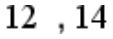



Since (x+y)=(x−y)+20, simplifying gives 2y=20, so y=10. Then calculate x=1.2×10=12.
The difference between the sum and the difference of two numbers x and y is equal to twice the smaller number.
Express x in terms of y using the percentage constraint, then substitute into the equation involving the sum and difference.
X's age is 20% more than Y's age (x = 1.2y). The sum of their ages (x + y) is 20 more than the difference (x - y).
x=1.2y,(x+y)=(x−y)+20
Since (x+y)=(x−y)+20, simplifying gives 2y=20, so y=10. Then calculate x=1.2×10=12.
Confusing the 20% increase constraint or misinterpreting '20 more than the difference' as 'difference is 20'.
Define relationships
Let X and Y be the ages. The first condition is X=Y+0.2Y=1.2Y.
X=1.2Y
Set up the second equation
The sum of ages exceeds the difference by 20, which is represented by (X+Y)=(X−Y)+20.
(X+Y)=(X−Y)+20
Simplify and solve for Y
Subtracting X from both sides results in Y=−Y+20, which simplifies to 2Y=20, hence Y=10.
2Y=20⟹Y=10
Solve for X
Substituting Y=10 into X=1.2Y gives X=1.2×10=12.
X=1.2×10=12
B is correct because the calculated ages are 12 and 10, which satisfy both given conditions (12=1.2×10 and 22=2+20).
This problem illustrates a property where for any two positive numbers, the difference between their sum and their difference is always twice the smaller number, a useful shortcut in data interpretation.
Get instant step-by-step AI explanations, full shift Previous Year Papers (SSC GD, RRB, SSC JE), and regional rank analysis on the official Examoogle App.
 Free Download • 100K+ Aspirants