
Join 60,000+ competitive exam aspirants
or with email
Your Cart
Subtotal₹0
Total₹0
Examoogle • User • info@examoogle.com • EE-2024-8821
Chapter 1 of 12 • Page 1 of 248🔒 Protected PDF • Watermarked
For a linearly elastic, homogeneous, and isotropic material having modulus of rigidity- G and modulus of elasticity- E, the range of G is given as ______.
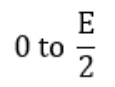
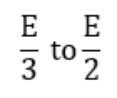
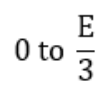
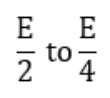
The modulus of rigidity G (also called shear modulus) and the modulus of elasticity E (Young's modulus) are related through Poisson's ratio ν by the expression E=2G(1+ν). For isotropic materials, the physical range of Poisson's ratio is 0≤ν≤0.5.
The modulus of rigidity G (also called shear modulus) and the modulus of elasticity E (Young's modulus) are related through Poisson's ratio ν by the expression E=2G(1+ν). For isotropic materials, the physical range of Poisson's ratio is 0≤ν≤0.5.
E=2G(1+ν) — Relationship between Elastic Moduli and Poisson's ratio
G=2(1+ν)E — Expression for Shear Modulus
0≤ν≤0.5 — Theoretical limits for Poisson's ratio
By substituting the limiting values of ν into the relationship G=2(1+ν)E, we determine the bounds for G. When ν=0, G=2E. When ν=0.5, G=2(1+0.5)E=3E. Thus, G ranges from 3E to 2E.
Poisson's ratio ν for isotropic materials lies between 0 (cork-like materials) and 0.5 (perfectly incompressible materials like rubber).
As ν increases, the material becomes more resistant to shear relative to its stiffness under tension.
The range of G is inversely proportional to the value of (1+ν).
Provides a clear physical constraint for material stability.
Allows calculation of shear properties given basic tensile properties.
Applicable only for isotropic, homogeneous, linearly elastic materials.
Structural design and stress analysis.
Material characterization in mechanical and civil engineering.
For most metals, ν is approximately 0.3, leading to G≈0.385E.
Option B represents the correct interval [3E,2E] derived from the thermodynamic stability limits of ν.
B is correct — The range of modulus of rigidity G is given as 3E to 2E.
Always remember that the limit ν=0.5 corresponds to an incompressible material, while ν=0 corresponds to a material with no lateral strain, forming the boundaries for all real isotropic elastic materials.
Get instant step-by-step AI explanations, full shift Previous Year Papers (SSC GD, RRB, SSC JE), and regional rank analysis on the official Examoogle App.
 Free Download • 100K+ Aspirants