
Join 60,000+ competitive exam aspirants
or with email
Your Cart
Subtotal₹0
Total₹0
Examoogle • User • info@examoogle.com • EE-2024-8821
Chapter 1 of 12 • Page 1 of 248🔒 Protected PDF • Watermarked
For a semicircular plate of diameter ‘D’ and radius ‘R’, with ‘y’ as the vertical axis passing through the diameter and ‘x’ as the horizontal axis passing through the diameter, the moment of inertia about the y axis will be:
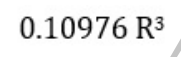

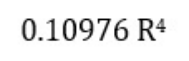

For a semicircular plate of radius R and diameter D, the moment of inertia about the axis passing through its diameter (either the horizontal x-axis or vertical y-axis in this context) is given by I=8πR4. Since R=2D, substituting this into the expression yields I=8π(D/2)4=16×8πD4=128πD4.
For a semicircular plate of radius R and diameter D, the moment of inertia about the axis passing through its diameter (either the horizontal x-axis or vertical y-axis in this context) is given by I=8πR4. Since R=2D, substituting this into the expression yields I=8π(D/2)4=16×8πD4=128πD4.
Idiameter=8πR4
Idiameter=128πD4
The moment of inertia for a full circle about its centroidal axis is I=4πR4=64πD4. A semicircular plate is exactly half of a full circle. By symmetry, the moment of inertia of the semicircular section about the diameter axis is simply half that of the full circle about its diametral axis.
The axis of symmetry for a semicircle is the diameter.
The moment of inertia I about the diameter is 21 of the I for a full circle of the same diameter.
The relationship between radius R and diameter D is R=2D.
Simplifies calculation of complex structural sections.
Essential for determining section modulus and bending stress.
Civil and Mechanical engineering structural design.
Calculation of bending stress in arched or semicircular members.
The Moment of Inertia about the diameter is Ixx=8πR4=128πD4.
Option D is the mathematically derived correct value.
D is correct — the moment of inertia of a semicircular plate about its diameter is 128πD4.
Remember that for a semicircle, I about the diameter is 8πR4. If asked about the centroidal axis parallel to the diameter, use the parallel axis theorem: Icentroidal=Idiameter−Ah2 where h=3π4R.
Get instant step-by-step AI explanations, full shift Previous Year Papers (SSC GD, RRB, SSC JE), and regional rank analysis on the official Examoogle App.
 Free Download • 100K+ Aspirants