
Join 60,000+ competitive exam aspirants
or with email
Your Cart
Subtotal₹0
Total₹0
Examoogle • User • info@examoogle.com • EE-2024-8821
Chapter 1 of 12 • Page 1 of 248🔒 Protected PDF • Watermarked
Join 60,000+ competitive exam aspirants
Study the following graph and answer the given question. The graph shows the number of articles sold in a week by different shops.
| Shop | Articles sold |
|---|---|
| A | 1500 |
| B | 1250 |
| C | 1500 |
| D | 1750 |
| E | 1000 |
What percentage of articles did shop C sell more than shop B?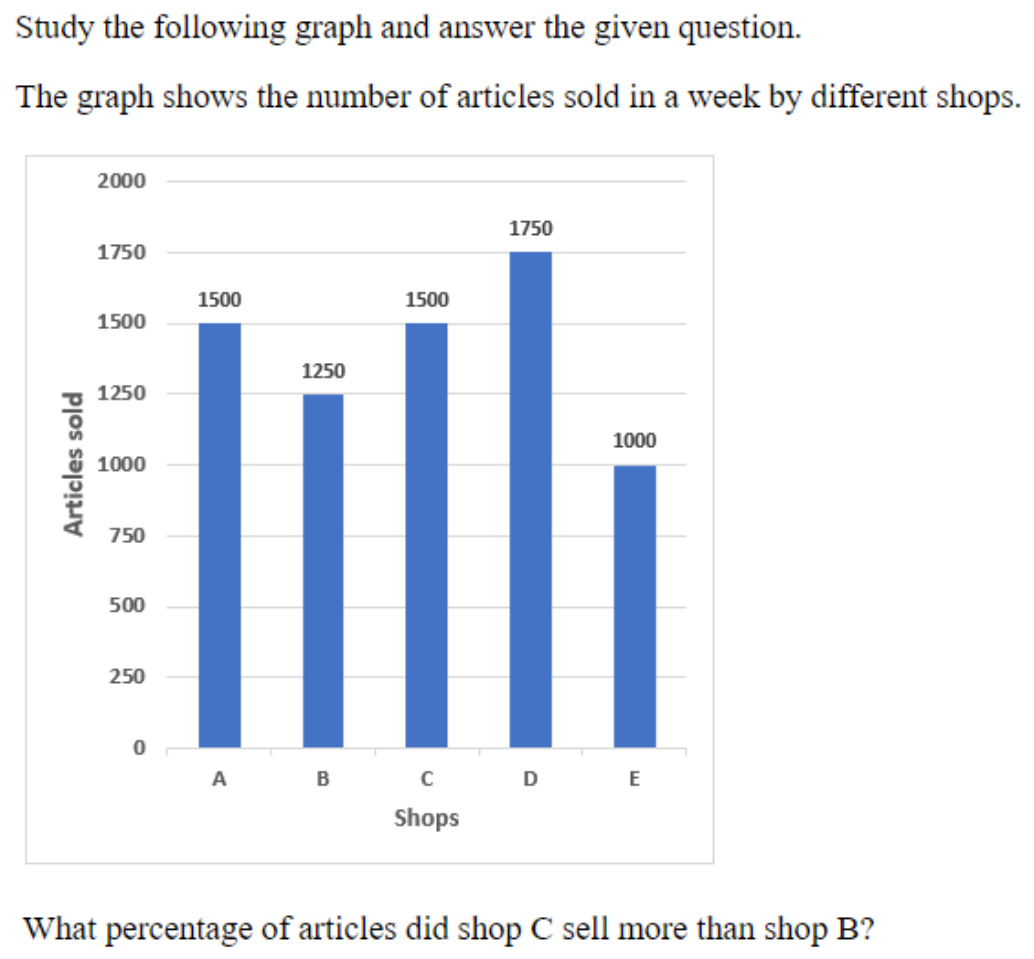
10%
20%
25%
30%
10%
Find the difference between shop C and shop B (1500 - 1250 = 250). Then calculate what percentage 250 is of shop B's sales (1250), which is 1250250×100=20%.
Number of articles sold by shop B = 1250, Number of articles sold by shop C = 1500
Percentage more=Articles in BArticles in C−Articles in B×100
Find the difference between shop C and shop B (1500 - 1250 = 250). Then calculate what percentage 250 is of shop B's sales (1250), which is 1250250×100=20%.
Using shop C's value in the denominator instead of shop B's value. The question asks how much more shop C sold than shop B, so shop B's value (1250) is the base.
Step 1: Identify values from graph
From the given bar graph, the number of articles sold by shop B is 1250 and by shop C is 1500.
Shop B=1250,Shop C=1500
Step 2: Calculate the difference in sales
Find how many more articles shop C sold than shop B by subtracting shop B's sales from shop C's sales.
Difference=1500−1250=250
Step 3: Apply percentage formula
Calculate the percentage increase relative to shop B's sales using the formula: Percentage more=Shop B salesDifference×100
Percentage=1250250×100=51×100=20%
A is correct because shop C sold 250 more articles than shop B, which is 1250250×100=20% more than shop B.
Always ensure the denominator is the base value of the entity being compared against (i.e., 'than shop B' implies shop B is in the denominator).
Get instant step-by-step AI explanations, full shift Previous Year Papers (SSC GD, RRB, SSC JE), and regional rank analysis on the official Examoogle App.
 Free Download • 100K+ Aspirants