
Join 60,000+ competitive exam aspirants
or with email
Your Cart
Subtotal₹0
Total₹0
Examoogle • User • info@examoogle.com • EE-2024-8821
Chapter 1 of 12 • Page 1 of 248🔒 Protected PDF • Watermarked
Join 60,000+ competitive exam aspirants
Study the following pie-chart and answer the question that follows.
The following pie chart shows the breakup of the percentage marks of Student A in an exam.
[Chart Title: Marks of student A in an exam] [Data from chart: Maths = 50%, Physics = 25%, Chemistry = 15%, English = 10%]
If the total marks scored by Student A are 260, then what are the total marks scored by the student in Physics and English in the exam?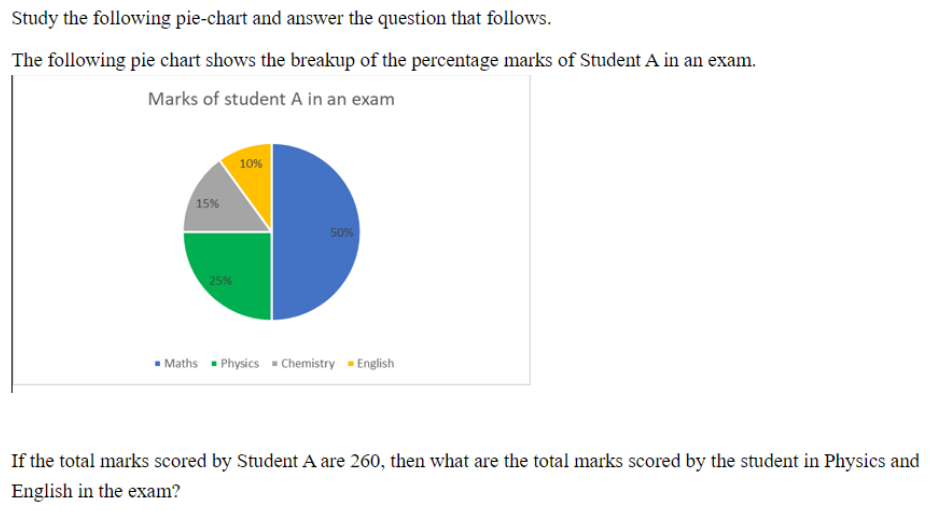
65
91
78
85
91
Calculate (Physics% + English%) of the Total marks: (25 + 10)% of 260 = 35% of 260. Since 10% is 26, 35% = (3 × 26) + 13 = 78 + 13 = 91.
Total marks = 260. Pie chart percentages: Maths = 50%, Physics = 25%, Chemistry = 15%, English = 10%.
Markstotal=100Percentage×Total Score
Calculate (Physics% + English%) of the Total marks: (25 + 10)% of 260 = 35% of 260. Since 10% is 26, 35% = (3 × 26) + 13 = 78 + 13 = 91.
Students often calculate the marks for each subject individually and then add them, which increases the chance of calculation errors; using the sum of percentages first is faster.
Identify given percentages
From the pie chart, Physics marks contribute 25% and English marks contribute 10% of the total score.
Psum=25%+10%=35%
Apply formula to calculate marks
Use the total marks (260) to find the combined value for both subjects.
Marks=10035×260
Calculate the final result
Perform the multiplication: 0.35×260=91.
Marks=91
B is correct because the sum of the percentages for Physics (25%) and English (10%) is 35%, and 35% of 260 equals 91.
In competitive exams, always look for the sum of components if the question asks for a combined total to save time on arithmetic.
Get instant step-by-step AI explanations, full shift Previous Year Papers (SSC GD, RRB, SSC JE), and regional rank analysis on the official Examoogle App.
 Free Download • 100K+ Aspirants