
Join 60,000+ competitive exam aspirants
or with email
Your Cart
Subtotal₹0
Total₹0
Examoogle • User • info@examoogle.com • EE-2024-8821
Chapter 1 of 12 • Page 1 of 248🔒 Protected PDF • Watermarked
Select the option figure that can replace the question mark (?) in the figure given below to complete the pattern.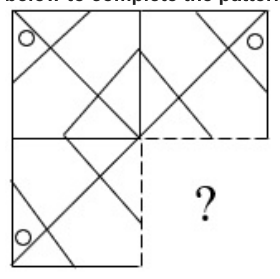
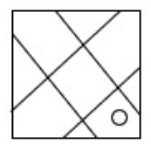
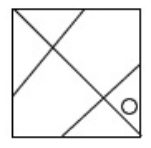
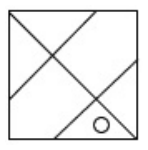

Observe the symmetry: the pattern is a square composed of four quadrants, where each quadrant mirrors or rotates its neighboring quadrants to complete diagonal and geometric lines.
Observe the symmetry: the pattern is a square composed of four quadrants, where each quadrant mirrors or rotates its neighboring quadrants to complete diagonal and geometric lines.
Analyze the Geometry
The overall figure is a square divided into four quadrants. The lines form a diagonal grid pattern inside each quadrant. The missing quadrant is the bottom-right one.
Trace the Lines
The diagonal line running from the top-left to the bottom-right of the whole square continues into the bottom-right quadrant. Additionally, the interior diagonal lines must complete the diamond shape formed in the center.
Locate the Element
Each quadrant contains a small circle in one of its corners. The top-left quadrant has the circle at the top-left, and the top-right quadrant has it at the top-right. Following the established rotational/reflective symmetry, the bottom-right quadrant must have the circle positioned in the bottom-right corner of its specific space.
A is wrong because the circle is in the wrong position relative to the diagonal intersection; C is wrong because the diagonal lines do not form the necessary segments; D is wrong because the circle is missing the correct orientation relative to the quadrant's boundary.
B is correct because it maintains the rotational symmetry of the diagonal lines and places the small circle accurately in the bottom-right corner of the missing quadrant.
In pattern completion, always check for the placement of small elements (like dots or symbols) first, as they are the easiest to distinguish and often eliminate most wrong options instantly.
Get instant step-by-step AI explanations, full shift Previous Year Papers (SSC GD, RRB, SSC JE), and regional rank analysis on the official Examoogle App.
 Free Download • 100K+ Aspirants