
Join 60,000+ competitive exam aspirants
or with email
Your Cart
Subtotal₹0
Total₹0
Examoogle • User • info@examoogle.com • EE-2024-8821
Chapter 1 of 12 • Page 1 of 248🔒 Protected PDF • Watermarked
Join 60,000+ competitive exam aspirants
Study the given diagram carefully and answer the question that follows. The numbers in different sections indicate the number of persons who own the given brands of car. How many persons own both MS and WB but not HM? (NOTE: You have to take the given data to be true even if they seem to be at variance from commonly known facts.)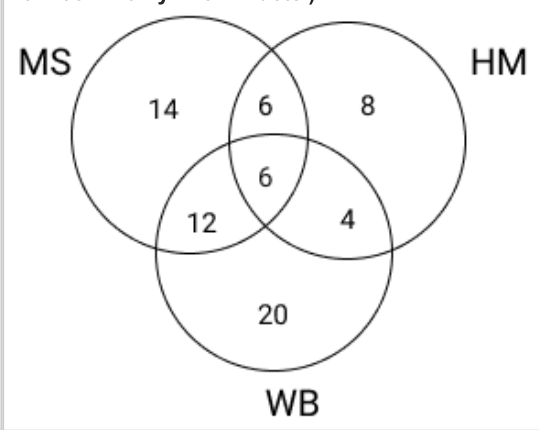
6
12
18
20
12
Focus only on the intersection region shared by MS and WB circles, then subtract any section that overlaps with the HM circle.
Focus only on the intersection region shared by MS and WB circles, then subtract any section that overlaps with the HM circle.
Identify Intersections
Locate the intersection region between the MS (Motorcycle/Car) circle and the WB (White/Brand) circle. This region contains two parts: a central section (common to MS, WB, and HM) and an exclusive section (common only to MS and WB).
Apply Exclusion Criteria
The question asks for those who own MS and WB, but NOT HM. The central region where all three overlap contains 6 people. The region shared only by MS and WB contains 12 people.
Conclusion
Since 12 represents the number of people in the MS-WB overlap that does not touch the HM circle, 12 is the final answer.
A: 18 is incorrect as it includes the triple overlap (12+6); C: 34 is the sum of various regions not matching the criteria; D: 8 refers to people who own only HM and MS.
B is correct because the region shared exclusively by MS and WB circles, excluding the common intersection with HM, contains 12 individuals.
In Venn diagram questions, always trace the circle boundaries carefully; 'but not' means you must subtract the overlap area corresponding to the excluded category.
Get instant step-by-step AI explanations, full shift Previous Year Papers (SSC GD, RRB, SSC JE), and regional rank analysis on the official Examoogle App.
 Free Download • 100K+ Aspirants