
Join 60,000+ competitive exam aspirants
or with email
Your Cart
Subtotal₹0
Total₹0
Examoogle • User • info@examoogle.com • EE-2024-8821
Chapter 1 of 12 • Page 1 of 248🔒 Protected PDF • Watermarked
Join 60,000+ competitive exam aspirants
Study the given diagram carefully and answer the question that follows. The numbers in different sections indicate the number of persons. How many such government servants are there who are Indians but not vegetarians?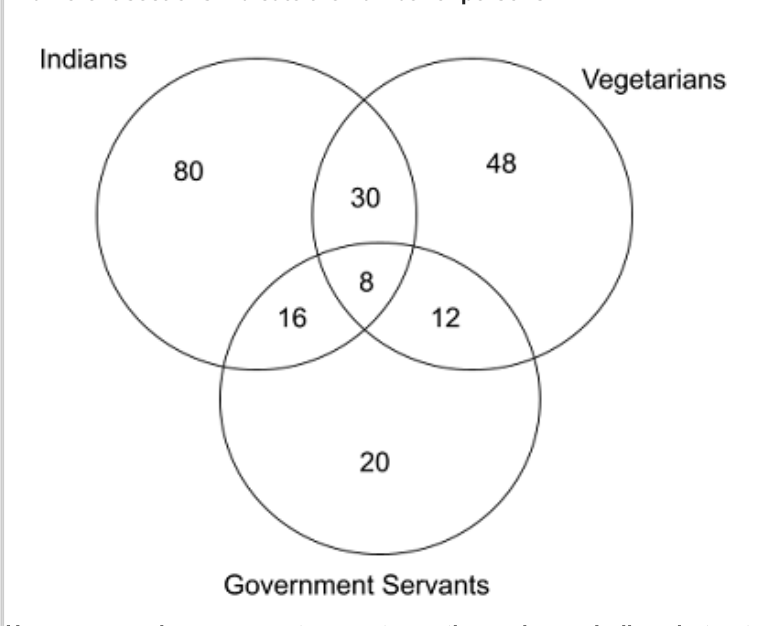
8
16
12
20
16
Identify the intersection of the two required sets (Indians and Government Servants) and subtract the part that overlaps with the excluded set (Vegetarians).
Identify the intersection of the two required sets (Indians and Government Servants) and subtract the part that overlaps with the excluded set (Vegetarians).
Analyze the conditions
The question asks for individuals who are 'Government Servants' AND 'Indians' but NOT 'Vegetarians'. This corresponds to the region that is common to the 'Indians' circle and the 'Government Servants' circle, excluding any region shared with the 'Vegetarians' circle.
Mapping the regions
Looking at the Venn diagram, the region common to 'Indians' and 'Government Servants' is composed of two segments: the segment with 16 and the central segment with 8. The segment with 8 is shared with the 'Vegetarians' circle. Therefore, we exclude the 8.
Calculation
The specific region representing Indians and Government Servants who are not vegetarians is the segment exclusively shared by these two circles, which contains the value 16.
A: 12 is the number of vegetarian government servants who are not Indians. C: 30 is the number of Indian vegetarians who are not government servants. D: 8 is the number of people who fall into all three categories (Indian, Vegetarian, and Government Servant).
B is correct because 16 is the only value situated in the intersection of the Indians and Government Servants sets that does not overlap with the Vegetarians set.
In Venn diagram questions, always start by identifying the common intersection of the required groups and then subtract any segments that belong to the 'not' category.
Get instant step-by-step AI explanations, full shift Previous Year Papers (SSC GD, RRB, SSC JE), and regional rank analysis on the official Examoogle App.
 Free Download • 100K+ Aspirants