
Join 60,000+ competitive exam aspirants
or with email
Your Cart
Subtotal₹0
Total₹0
Examoogle • User • info@examoogle.com • EE-2024-8821
Chapter 1 of 12 • Page 1 of 248🔒 Protected PDF • Watermarked
Join 60,000+ competitive exam aspirants
A man standing at a point on level ground observes the top of a vertical tower at an angle of elevation of 30°. He then walks straight towards the tower and finds that the angle of elevation of the top becomes 60°. If the height of the tower is 45 m, find the distance walked by the man.
60 m
30 m
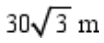
Question ID: 441009601030 Option 1 ID: 4410092359237 Option 2 ID: 4410092359239 Option 3 ID: 4410092359238 Option 4 ID: 4410092359240 Status: Answered Chosen Option: C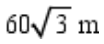
For a tower of height h, the distance walked between angles 30° and 60° is given by h×32 or h×323. Here 45×32=303.
Height of the tower h = 45 m, initial angle of elevation = 30°, final angle of elevation = 60°.
Distance=h×(cot(θ1)−cot(θ2))
For a tower of height h, the distance walked between angles 30° and 60° is given by h×32 or h×323. Here 45×32=303.
Students often calculate only the distance from the second point to the tower (3h) instead of the total distance moved between the two points.
Setup the Trigonometric Ratios
Let the height of the tower be h=45 m. Let the distance from the tower at 30° be d1 and at 60° be d2. We use d=hcot(θ).
d1=45cot(30°)=453,d2=45cot(60°)=345=153
Calculate the Distance Walked
The distance walked is the difference between the two horizontal distances: d1−d2.
Distance=453−153=303 m
C is correct because the distance walked is 453−153=303 m.
This problem is a specific case of the general formula d=h(cotθ2−cotθ1), which is highly useful in coordinate geometry problems involving lines and slopes.
Get instant step-by-step AI explanations, full shift Previous Year Papers (SSC GD, RRB, SSC JE), and regional rank analysis on the official Examoogle App.
 Free Download • 100K+ Aspirants