
Join 60,000+ competitive exam aspirants
or with email
Your Cart
Subtotal₹0
Total₹0
Examoogle • User • info@examoogle.com • EE-2024-8821
Chapter 1 of 12 • Page 1 of 248🔒 Protected PDF • Watermarked
Join 60,000+ competitive exam aspirants
The figure below represents a catchment area with the precipitations observed in a year. The mean precipitation calculated by using the Thiessen polygon method is ____________.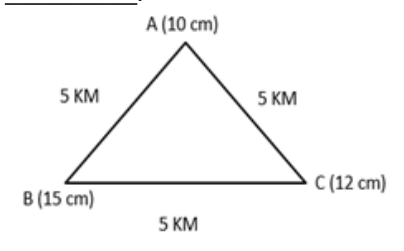
11.28 cm
13.45 cm
12.33 cm
14.46 cm
12.33 cm
The Thiessen polygon method calculates the mean areal precipitation by weighting the rainfall recorded at each gauge station by the area of the polygon (influence area) assigned to that station. In an equilateral triangle with equal side lengths of 5 km, the centroid divides the area equally, meaning each gauge station (A, B, and C) influences one-third of the total catchment area.
The Thiessen polygon method calculates the mean areal precipitation by weighting the rainfall recorded at each gauge station by the area of the polygon (influence area) assigned to that station. In an equilateral triangle with equal side lengths of 5 km, the centroid divides the area equally, meaning each gauge station (A, B, and C) influences one-third of the total catchment area.
Pavg=∑i=1nAi∑i=1nPiAi — Area-weighted average precipitation formula
Atotal=43a2 — Area of an equilateral triangle with side length a
The catchment area is partitioned into polygons such that any point within a polygon is closer to the associated rain gauge than to any other. Since the triangle is equilateral with side length a=5 km, the total area Atotal=43a2. Because the stations are at the vertices and the geometry is symmetric, the influence area for each station is AA=AB=AC=3Atotal. The mean precipitation is the area-weighted average: Pavg=∑Ai∑(Pi×Ai)=310+15+12=337=12.33 cm.
Thiessen method accounts for the spatial distribution of rainfall stations.
Equal areas are assigned to each station in an equilateral configuration.
The calculation simplifies to a simple arithmetic mean when all influence areas are equal.
More accurate than the arithmetic mean method.
Provides a systematic way to assign weights to unevenly distributed stations.
Does not account for orographic effects or elevation changes.
The polygons are fixed even if rainfall distribution changes seasonally.
Estimating total volume of rainfall over a watershed.
Determining the average depth of precipitation for hydrological modeling.
The calculation is Pavg=310+15+12=12.333... cm.
Option C is the only mathematically consistent result based on the provided station data.
C is correct — The mean precipitation is calculated by dividing the sum of observed precipitations by the number of stations, resulting in 12.33 cm.
If rainfall gauges are uniformly distributed or the catchment geometry is highly symmetric, the Thiessen polygon method converges to the simple arithmetic mean.
Get instant step-by-step AI explanations, full shift Previous Year Papers (SSC GD, RRB, SSC JE), and regional rank analysis on the official Examoogle App.
 Free Download • 100K+ Aspirants