
Join 60,000+ competitive exam aspirants
or with email
Your Cart
Subtotal₹0
Total₹0
Examoogle • User • info@examoogle.com • EE-2024-8821
Chapter 1 of 12 • Page 1 of 248🔒 Protected PDF • Watermarked
Which of the given option provides the effective width of an isolated T- beam of RCC as per IS 456-2000? Assume - b f =effective width of flange, I 0 = distance between points of zero moments in the beam, b w = breadth of the web, D f = thickness of flange and b = actual width of the flange.
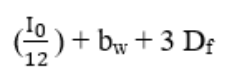
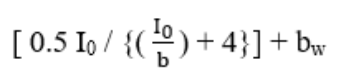
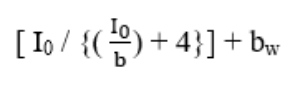
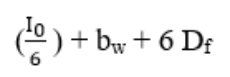
According to IS 456:2000, for an isolated T-beam (which behaves differently than a T-beam integrated into a slab), the effective width of the flange (bf) is restricted by the geometry of the beam to prevent local buckling and ensure monolithic behavior. The standard formula explicitly accounts for the distance between points of zero moments (I0), the actual width of the flange (b), and the breadth of the web (bw).
IS 456:2000 Cl. 23.1.2
According to IS 456:2000, for an isolated T-beam (which behaves differently than a T-beam integrated into a slab), the effective width of the flange (bf) is restricted by the geometry of the beam to prevent local buckling and ensure monolithic behavior. The standard formula explicitly accounts for the distance between points of zero moments (I0), the actual width of the flange (b), and the breadth of the web (bw).
bf=bI0+4I0+bw — Represents the effective width of an isolated T-beam.
bf=bI0+40.5I0+bw — Represents the effective width of an isolated L-beam.
The effective width of the flange is limited to prevent an overestimation of the compression zone stiffness and to ensure the beam acts as a single integrated unit. The provision bf=bI0+4I0+bw balances the distribution of compressive stresses across the flange for isolated sections where the shear lag effect is more pronounced than in T-beams supporting monolithic slabs.
The parameter I0 represents the distance between points of zero moments (inflection points).
For continuous beams, I0 can be approximated as 0.7 times the effective span.
The effective width bf cannot exceed the actual width b of the flange.
Isolated T-beams have stricter requirements than T-beams that are cast monolithically with a slab.
Ensures structural integrity by preventing non-conservative designs.
Correctly accounts for the stress distribution in isolated compression flanges.
More conservative than monolithic beam design formulas.
Requires knowledge of the zero-moment locations in the beam.
Design of standalone T-shaped beams.
Precast concrete beam design where the flange is cast separately or isolated.
The formula in Option C is the correct standard provision for isolated T-beams.
Option B is the corresponding formula for isolated L-beams, which uses a factor of 0.5 for the I0 term.
The formulas in Options A and D are not recognized standard expressions for effective flange width.
C is correct — The formula for the effective width of an isolated T-beam is given by bI0+4I0+bw.
Remember that isolated beams use the denominator term (bI0+4), while T-beams supporting slabs use simplified span-based ratios (e.g., 6I0+bw+6Df).
Get instant step-by-step AI explanations, full shift Previous Year Papers (SSC GD, RRB, SSC JE), and regional rank analysis on the official Examoogle App.
 Free Download • 100K+ Aspirants