
Join 60,000+ competitive exam aspirants
or with email
Your Cart
Subtotal₹0
Total₹0
Examoogle • User • info@examoogle.com • EE-2024-8821
Chapter 1 of 12 • Page 1 of 248🔒 Protected PDF • Watermarked
Join 60,000+ competitive exam aspirants
Match the following.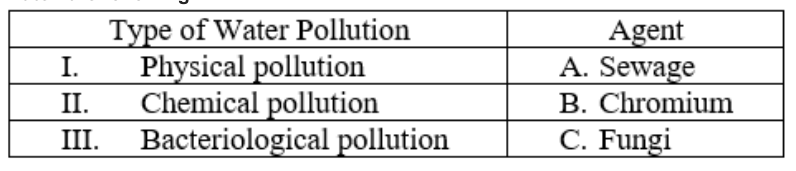
I-B, II-A, III-C
I-A, II-B, III-C
I-B, II-C, III-A
I-A, II-C, III-B
I-A, II-B, III-C
Water pollution is categorized based on the nature of the contaminants. Physical pollution involves changes to the physical characteristics of water such as turbidity or temperature, often caused by sewage; chemical pollution involves the introduction of harmful substances like heavy metals (e.g., Chromium) into the water; and bacteriological pollution refers to the contamination by microorganisms including bacteria, viruses, and fungi.
IS 10500:2012 (Drinking Water Specification)
Water pollution is categorized based on the nature of the contaminants. Physical pollution involves changes to the physical characteristics of water such as turbidity or temperature, often caused by sewage; chemical pollution involves the introduction of harmful substances like heavy metals (e.g., Chromium) into the water; and bacteriological pollution refers to the contamination by microorganisms including bacteria, viruses, and fungi.
BOD=Dissolved Oxygeninitial−Dissolved Oxygenfinal
pH=−log10[H+]
Pollutants degrade water quality by disrupting biological and chemical balance. Sewage introduces organic loads and suspended solids, Chromium is a toxic industrial effluent causing chemical toxicity, and Fungi act as pathogenic or nuisance biological agents that contaminate water bodies.
Physical pollution includes parameters like turbidity, color, and temperature.
Chemical pollution is often assessed by concentration levels of heavy metals and toxic ions.
Bacteriological assessment is typically done using coliform counts or pathogen identification.
Chromium is a classic industrial pollutant, specifically found in tannery and electroplating effluents.
Standardized classification aids in selecting appropriate water treatment processes.
Different treatment methods like filtration (physical), precipitation (chemical), and disinfection (bacteriological) are applied based on these types.
Combined pollutants often require multi-stage treatment plants, increasing capital costs.
Detecting specific pollutants requires specialized laboratory testing.
Environmental engineering water quality analysis.
Municipal wastewater treatment plant design.
Industrial effluent monitoring.
Chromium is particularly hazardous in its hexavalent form, Cr(VI), which is highly carcinogenic.
Option B represents the correct matching: I-A (Physical-Sewage), II-B (Chemical-Chromium), III-C (Bacteriological-Fungi).
B is correct — I corresponds to A, II corresponds to B, and III corresponds to C.
Remember that physical, chemical, and biological (bacteriological) are the three primary pillars of water quality assessment; always link them to their respective removal mechanisms: physical removal for physical pollution, chemical reactions for chemical pollution, and disinfection for bacteriological pollution.
Get instant step-by-step AI explanations, full shift Previous Year Papers (SSC GD, RRB, SSC JE), and regional rank analysis on the official Examoogle App.
 Free Download • 100K+ Aspirants