
Join 60,000+ competitive exam aspirants
or with email
Your Cart
Subtotal₹0
Total₹0
Examoogle • User • info@examoogle.com • EE-2024-8821
Chapter 1 of 12 • Page 1 of 248🔒 Protected PDF • Watermarked
Join 60,000+ competitive exam aspirants
60
12.67
24
2.5
60
The multiplying constant of a tacheometer, denoted by k, is defined as the ratio of the focal length of the objective lens (f) to the interval between the stadia hairs (i). It represents the multiplier applied to the observed staff intercept to determine the horizontal distance from the instrument's focal point to the staff.
The multiplying constant of a tacheometer, denoted by k, is defined as the ratio of the focal length of the objective lens (f) to the interval between the stadia hairs (i). It represents the multiplier applied to the observed staff intercept to determine the horizontal distance from the instrument's focal point to the staff.
k=if — Formula for the multiplying constant
c=f+d — Formula for the additive constant
D=ks+c — Fundamental tacheometric equation
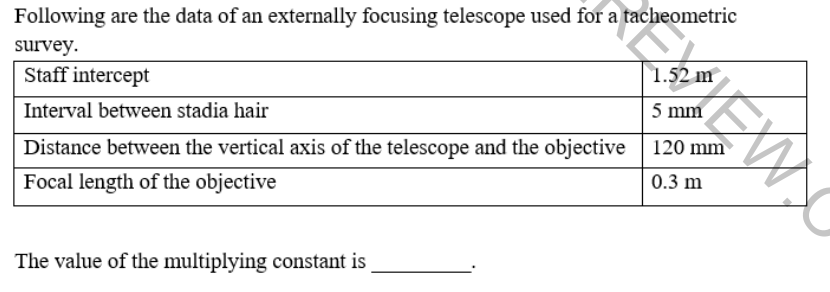
In a basic tacheometer, the horizontal distance D is given by the formula D=ks+c, where s is the staff intercept, k=f/i is the multiplying constant, and c=f+d is the additive constant. Given the focal length f=0.3 m (or 300 mm) and the stadia hair interval i=5 mm, the multiplying constant is calculated as k=300/5=60.
Multiplying constant k is dimensionless.
Stadia hair interval i must be in the same unit as focal length f for the ratio.
Common values for k in surveying telescopes are typically 100, but depend on specific optical design.
The additive constant c accounts for the distance from the objective to the vertical axis d and the focal length f.
Allows rapid determination of horizontal distances without chaining.
Suitable for rough terrain where direct measurement is difficult.
Requires high-precision optics and regular calibration.
Accuracy is limited by atmospheric refraction and staff reading errors.
Topographic mapping.
Hydrographic surveying.
Reconnaissance surveys.
Given values: f=0.3 m=300 mm, i=5 mm.
k=5300=60.
The distance d (120 mm) provided in the question is used to calculate the additive constant (c=f+d=300+120=420 mm), but it is not required for the multiplying constant.
A is correct — The multiplying constant is calculated as the ratio of focal length to stadia hair interval, resulting in 60.
Always ensure units for f and i are consistent (e.g., both in mm) before calculating the ratio f/i to avoid unit conversion errors in competitive exams.
Get instant step-by-step AI explanations, full shift Previous Year Papers (SSC GD, RRB, SSC JE), and regional rank analysis on the official Examoogle App.
 Free Download • 100K+ Aspirants