
Join 60,000+ competitive exam aspirants
or with email
Your Cart
Subtotal₹0
Total₹0
Examoogle • User • info@examoogle.com • EE-2024-8821
Chapter 1 of 12 • Page 1 of 248🔒 Protected PDF • Watermarked
Join 60,000+ competitive exam aspirants
Which of the following statements is INCORRECT?

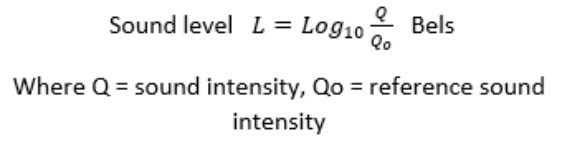


The statement claiming that the threshold of human hearing is approximately 10 micropascals is incorrect. The standard reference sound pressure for hearing in air is actually 20 micropascals (μPa), which corresponds to 0 dBSPL (Sound Pressure Level).
ISO 1683:2015 (Acoustics - Preferred reference quantities for acoustic levels)
The statement claiming that the threshold of human hearing is approximately 10 micropascals is incorrect. The standard reference sound pressure for hearing in air is actually 20 micropascals (μPa), which corresponds to 0 dBSPL (Sound Pressure Level).
Lp=20log10(p0p) dB — Sound Pressure Level formula where p0=20μPa
LI=10log10(I0I) dB — Sound Intensity Level formula where I0=10−12 W/m2
Sound levels are measured on a logarithmic scale because human perception of sound intensity is non-linear and spans a massive range. A reference value (Q0 or p0) is essential to define the baseline of 0 dB, which is set to the absolute threshold of hearing for a healthy human ear at 1 kHz.
The threshold of human hearing in air is 20μPa (2×10⁻⁵ Pa).
Sound pressure levels are calculated using a logarithmic scale to compress the vast range of human auditory sensitivity.
Bels are the base unit of the logarithmic ratio, but decibels (dB) are commonly used as the practical unit.
Sound intensity (I) is proportional to the square of sound pressure (p), hence the factor of 20 in the pressure formula versus 10 in the intensity formula.
Logarithmic scales simplify calculations involving ratios.
Matches the human ear's logarithmic response to stimulus.
Requires reference points to be meaningful.
Can be confusing due to different reference values for different media (e.g., 1μPa for underwater sound).
Environmental noise monitoring.
Acoustic engineering and room design.
Audio equipment specification.
The reference sound pressure in air is fixed at 20μPa for international standardization.
Option D is incorrect because it cites 10μPa, which is half the actual standardized threshold.
D is correct — The value 10μPa is scientifically inaccurate as the threshold of human hearing is standardized at 20μPa.
Always remember the standard reference pressure for air is 20μPa and for water is 1μPa, as exam questions often swap these to test conceptual clarity.
Get instant step-by-step AI explanations, full shift Previous Year Papers (SSC GD, RRB, SSC JE), and regional rank analysis on the official Examoogle App.
 Free Download • 100K+ Aspirants