
Join 60,000+ competitive exam aspirants
or with email
Your Cart
Subtotal₹0
Total₹0
Examoogle • User • info@examoogle.com • EE-2024-8821
Chapter 1 of 12 • Page 1 of 248🔒 Protected PDF • Watermarked
Two simply supported beams with central (mid span) concentrated loads have the following particulars. Compare the slope at the ends.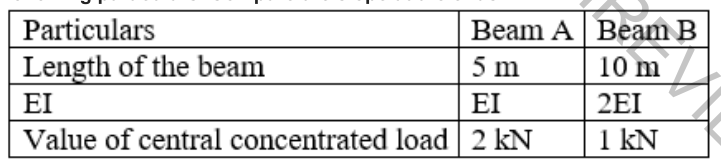
Slope of beam A = Slope of beam B
Slope of beam A < Slope of beam B
Insufficient data to compare the slopes
Slope of beam A > Slope of beam B
Slope of beam A = Slope of beam B
For a simply supported beam with a central point load P, the slope θ at the supports is given by the formula θ=16EIPL2. By calculating this value for both Beam A and Beam B, we find that the resulting slopes are equal, confirming that the structural parameters balance out perfectly.
For a simply supported beam with a central point load P, the slope θ at the supports is given by the formula θ=16EIPL2. By calculating this value for both Beam A and Beam B, we find that the resulting slopes are equal, confirming that the structural parameters balance out perfectly.
θ=16EIPL2 — Formula for slope at supports of a simply supported beam with central load P
The slope at the support of a simply supported beam is directly proportional to the load (P) and the square of the length (L2), and inversely proportional to the flexural rigidity (EI). Given the specific values provided in the table, the ratio EIPL2 for Beam A is equivalent to that of Beam B, leading to identical end rotations.
Beam A: PA=2 kN, LA=5 m, (EI)A=EI
Beam B: PB=1 kN, LB=10 m, (EI)B=2EI
Calculation for A: θA=16×EI2×52=16EI50=EI3.125
Calculation for B: θB=16×2EI1×102=32EI100=EI3.125
Identifies fundamental beam behavior under point loads
Demonstrates the interplay between length and stiffness
Structural analysis of simply supported beams
Design calculations for deflection-limited members
| Feature | Beam A | Beam B |
|---|---|---|
Load (P) | 2 kN | 1 kN |
Length (L) | 5 m | 10 m |
Flexural Rigidity (EI) | EI | 2EI |
End Slope (θ) | 3.125/EI | 3.125/EI |
The calculation shows θA=θB, which confirms Option A.
Option B, C, and D are incorrect because they fail to account for the inverse scaling of length squared versus stiffness.
A is correct — The calculated slopes at the ends of both beams are numerically identical due to the specific combination of loading, span, and rigidity.
In competitive exams, always check if parameters satisfy proportions (e.g., P1L12/(EI)1=P2L22/(EI)2) before calculating absolute values to save time.
Get instant step-by-step AI explanations, full shift Previous Year Papers (SSC GD, RRB, SSC JE), and regional rank analysis on the official Examoogle App.
 Free Download • 100K+ Aspirants